
Endurance Isn't Resilience And How To Stop Living That Version
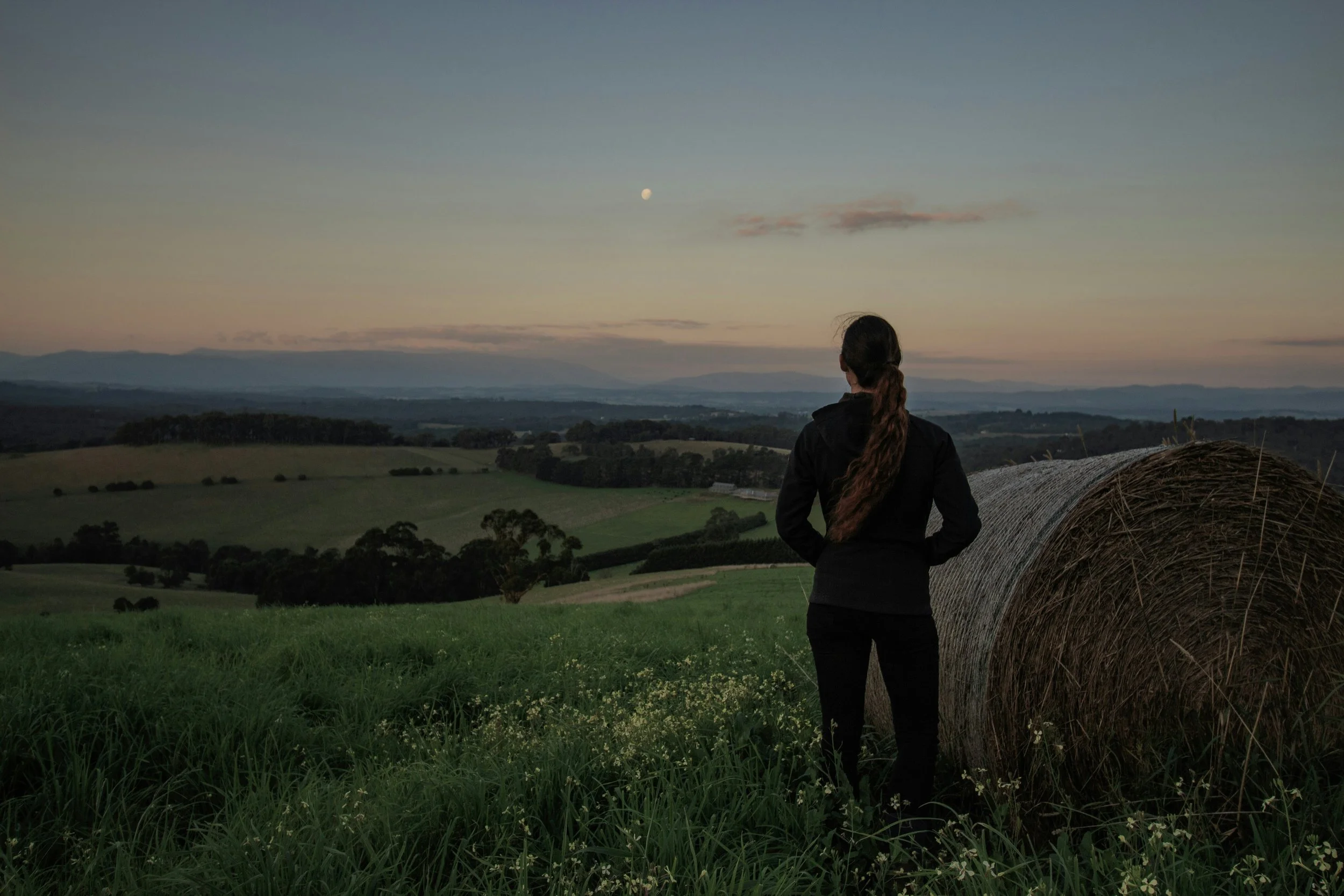
If you've spent any time in a rural or ag lifestyle, you'll know the script.
When you think about women from the land.
She's strong. She can do anything. She just gets on with it. She doesn't complain.
It gets said like a compliment. And for a long time, most of us took it as one.
The problem is, we've been sold a version of resilience that was never actually about the human and their wellbeing. It was about output. About staying functional. About not becoming another problem to deal with. And in rural regions especially, that version has been so heavily publicised and marketed, the farmer who takes the hit, gets back up, and keeps going, season after season, that it stops being something people do and becomes something people believe they are.
It gets absorbed. Into the identity. Into the self-concept. Into the quiet belief that if you're struggling, if you're not keeping up, if you're not bouncing back fast enough, you're failing at being the kind of person the land requires you to be.
Farming isn't just a job. It's a way of life. There's no clocking off from it, no clean separation between who you are and what you do. The land, the animals, the generational blueprint, the roles, they all blur into one. And somewhere in that blur, the idea that you push through no matter what stopped being a coping strategy and became the expectation.
For generations, that version of strength has been modelled. The put up, shut up, keep up version. And it gets passed down. Not through words, but through watching. Seeing those who came before you carry so much, without ever really asking whether the weight was theirs to carry in the first place.
Women in rural communities have always been the backbone of it all. The connectors, the caregivers, the ones keeping families and communities functioning and right there in the thick of the daily farm duties too. The domestic load, the emotional load, the community load, and the physical labour load. All of it, carried by the same person. And if you ask any of them how they do it, it's just what you have to do.
So they do. Year after year. Without really stopping to ask what it's costing them.
And if ever that flat, overwhelmed, pulled-in-every-direction feeling does creep in? They push it back down. Like a beachball held underwater, it takes constant energy just to keep it there, and the moment you lose your grip, it comes flying back up. Because everyone around them works hard. Because there's always more to do. Because who are they to feel like something's internally missing when there are bills to pay, kids to feed and a farm that needs fighting for?
I get it. Even in today's landscape. There's a lot at stake when the world is so volatile right now.
So they don't say it out loud. Most of the time they barely let themselves think it. They just keep going.
And when life hits hard, which it always does, they do what they've always done. They work harder. Give more. Hold tighter. They don't question the operating system. They just try to run it faster.
Until one day life forces them to stop.

My version of that story
I stepped into a life I knew almost nothing about.
I'd been a hairdresser. I knew hairstyles, I knew people, I knew how to hold a conversation and make someone feel good in a chair. What I didn't know was dairy farming. I didn't know what was expected of me, what the roles would look like, or honestly what I was walking into when I said yes to this life.
My husband's family had been dairy farming for three generations. When we married, we bought the farm. And just like that, I was a farmer by default.
I was 21. Already a young mum. And now a farmer's wife, which meant I was also the one sorting the admin, plugging the gaps between getting cows in, bus runs, feeding calves, paying staff, managing rosters, and filling whatever space needed filling on any given day. Not because I had itemised job descriptions. It just landed. Because I was there. Because I could. Because I had to.
We were constantly scaling, not from ambition exactly, but because we had to in order to stay afloat. More land, more stock, a contracting business, more farms. And with every expansion, more responsibilities found their way onto my list.
I had stern talks with myself through all of it. You chose this beast, Melissa. It's part of the package you signed up for. You just need to keep up.
And when I'd voice the overwhelm and someone would say "it is what it is," I heard failure. Like the fact that I was struggling meant something was wrong with me. So I kept pushing. In the hope that one day I'd feel like I was succeeding at something, in some way.
My nervous system was a mess. Waking at 3am with a head full of everything I hadn't finished. High blood pressure. Moods all over the place. Highly functioning. Technically. But running on survival tactics. Just getting by.
I was living so far outside of anything that actually mattered to me that I'd stopped noticing the gap.
I was demonstrating, without even knowing it, that I didn't matter to me. The business did.
The year everything stopped.
2016. By that point we were running four dairy farms, a contracting business, skeleton crews across all of them, and problems were popping up like spot fires constantly.
One morning I went to feed calves before the school bus run. I hadn't told anyone where I was going. My brain was already three steps ahead, the wedding I was in that weekend, the tasks I needed to get through, the to-do list I was struggling to keep up with.
Then a text came through. Staff member quitting. Effective immediately.
I remember thinking, I just need a bloody break.
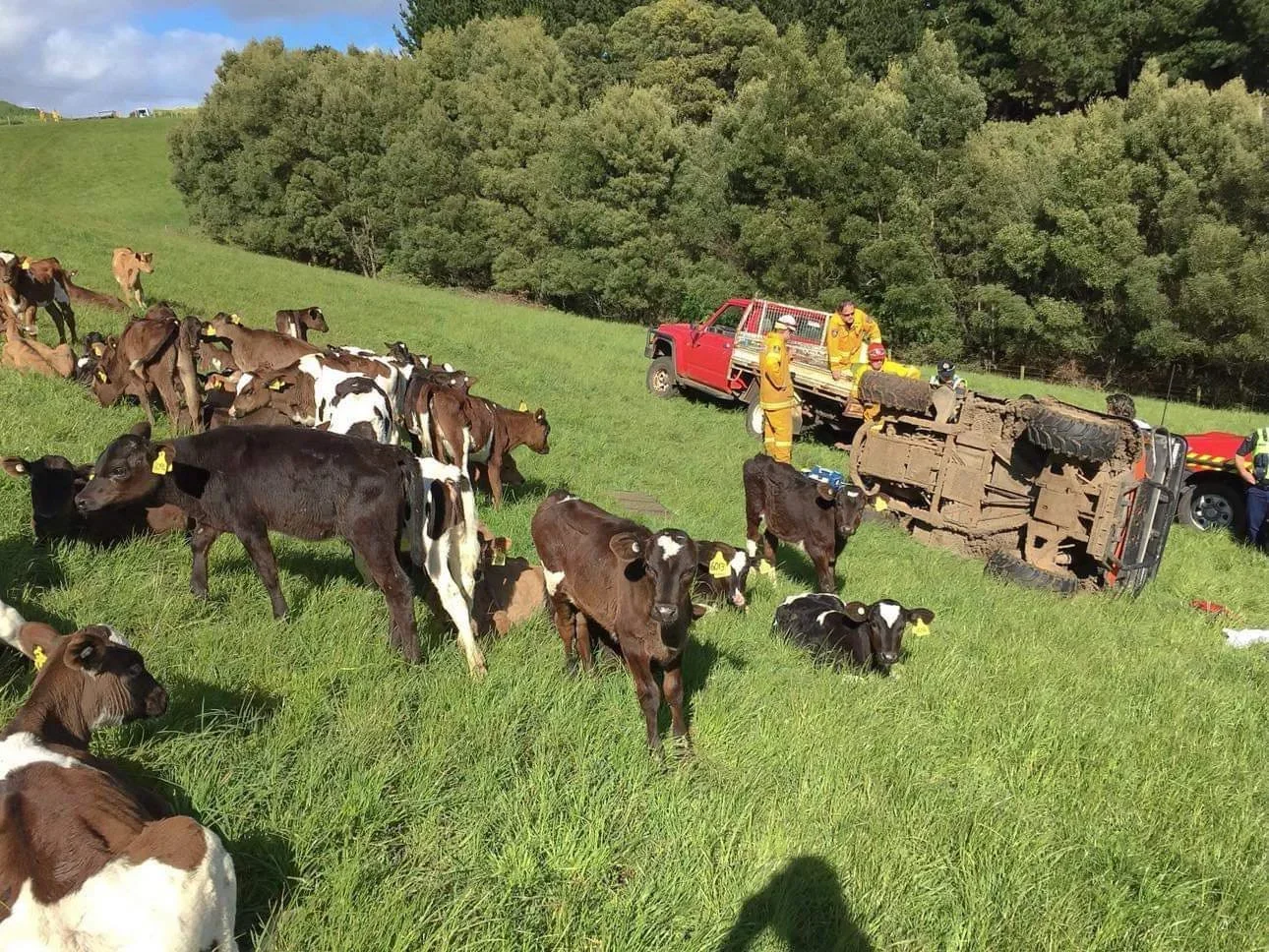
Seconds later, I rolled the buggy. Compound crush injury to my leg under the roll bar. Trapped for almost three hours while emergency services tried to reach me. When I crashed, the phone landed in front of me, the only reason I was able to call for help that day.
When my husband finally reached me, do you know what I said? It wasn't help me, get me out, or get it off me.
I'm sorry. I'm sorry. I'm so sorry.
Over and over. An apology. As if the accident was an inconvenience. As if the most urgent thing in that moment was making sure I wasn't adding to someone else's busy load.
That detail still gets me. Because it tells you everything about how deep that inner wiring goes.
What sitting still forced me to see
I spent the next two years recovering in a chair. So many surgeries, infections, and very close to losing my leg. A long time to sit flat on my arse, with nothing but my own company and no busyness to hide behind.
The feedback I got from people who cared about me was meant to be encouraging. "God you're lucky." "Others on farms have done the same thing." "At least you get a rest." As if I should be grateful for the forced downtime. As if this was some kind of break I'd been waiting for.
But underneath all of that, I felt exposed. Incapable. Not enough. I couldn't do anything for anyone. I couldn't carry the roles. And without the roles, and this is the part that really got me, I had no real idea who I was.
This is what women's emotional exhaustion actually looks like at its endpoint. Not dramatic. Just quietly hollowed out.
One day in that chair, I broke down. Sobbed solidly for two straight days. A friend came in and found me in that state and said, "Melissa. What's wrong?"
All I could say was, "What's f***ing right?"
That was my rock bottom. Not the accident. Not the leg. But the moment I realised I'd been trying so hard to solve the problem I had created, still broken, still in survival mode, still with no tools. Still trying to perform that version of resilience while becoming completely undone on the inside.
Sitting in that chair, with nothing to fill the space, I finally started to see it.
My entire sense of who I thought I was had been wrapped up in the roles. Farmer. Gap filler. Wife. Mum. The one who is capable and gets things done. I had drifted so far from my own emotional compass, from my values, my needs, what actually mattered to me, that I didn't even know what being in alignment with myself would feel like anymore.
This is the real cost of loss of identity in roles. Not one dramatic moment. Years of slow drift, until the person underneath all the doing becomes a stranger to herself.
I wasn't living by design. I was living on default.
The version of resilience we've been sold is a problem
Here's what I want you to hear in this.
What happened to me wasn't just personal. It wasn't just a farming story or a bad day that went sideways. It was the end point of a system that tells women, especially women in rural communities, that endurance is the same thing as strength.
It's not.
Endurance is staying in it. Absorbing more. Keeping going when everything in you is asking for something different. It's useful. But it has a cost, and the cost compounds quietly over years before it shows up somewhere you can't ignore.
Real resilience is different. It's the ability to move through hard things without losing yourself in them. It requires actually knowing yourself, your patterns, your values, what depletes you and what restores you, and making decisions from that place instead of from habit, obligation, and the story that says good women just keep going.
The version that's been modelled for generations, put up, shut up, keep up, never asked women to check in with themselves. It just asked them to keep producing. Keep carrying. Keep showing up for everyone else. And for the most capable, giving women, that system works brilliantly. Right up until the moment it doesn't.
Most women I work with don't roll a buggy in a paddock to hit their rock bottom. But most of them have had a version of that. The thing that finally made them stop and ask: Is this actually working for me? Or have I just been very good at making it look like it is?

So what actually changes things
It's not about working less or caring less or burning down the life you've built.
It starts with learning to notice. What is your inner state telling you that you've been overriding? Your body picks things up long before your mind is ready to admit them. Tired. Wired. Resentful. Numb. A one-word symptom is data. Start there.
Then it moves into asking more honest questions. Not "how can I keep up?" but "what actually matters to me right now, not what used to matter, not what should matter, right now?" And if I honoured that, what would I stop? What would I start?
And then there's the boundary piece, which sounds simple and isn't. Practising the ability to say: I'm not available for that right now. No justification. No apology. That whole sentence.
None of this is soft. All of it is hard. Because it asks you to lead from something real instead of from expectation and momentum. And for women who've spent years being rewarded for their capacity to give and carry and hold, choosing themselves first feels like going against the grain of everything they know.
But here's the thing. When you stop performing strength and start actually feeling it, something changes. Decisions come from clarity instead of pressure. You stop overriding yourself to accommodate everyone else. And you start modelling something different, a kind of strength that doesn't cost you yourself.
That's not soft. That's self-loyalty.
The question worth sitting with
Somewhere along the line, most capable women learn that pushing through is what strength looks like. They get praised for it. Rewarded for it. So of course it becomes the norm.
But staying needed while slowly disappearing inside the roles, that's not resilience. It's just a very convincing performative version of it.
The real question isn't am I strong enough?
It's is this version of strong still working for me?
Because the operating system that got you here might need updating. Not a complete rebuild. Just an honest look at what's still working, what's not, and what you've been unconsciously running in the background out of loyalty to an older version of yourself.
That's where the real work starts. Not in pushing harder. In finally being willing to look.
And that willingness, passing that on, that's the legacy I want to lead.
If something in this resonated, I'd love to hear your version. And if you're ready to do some of that looking, whether that's through having a conversation an event or something deeper, you can find out more at leadingrein.com.au